
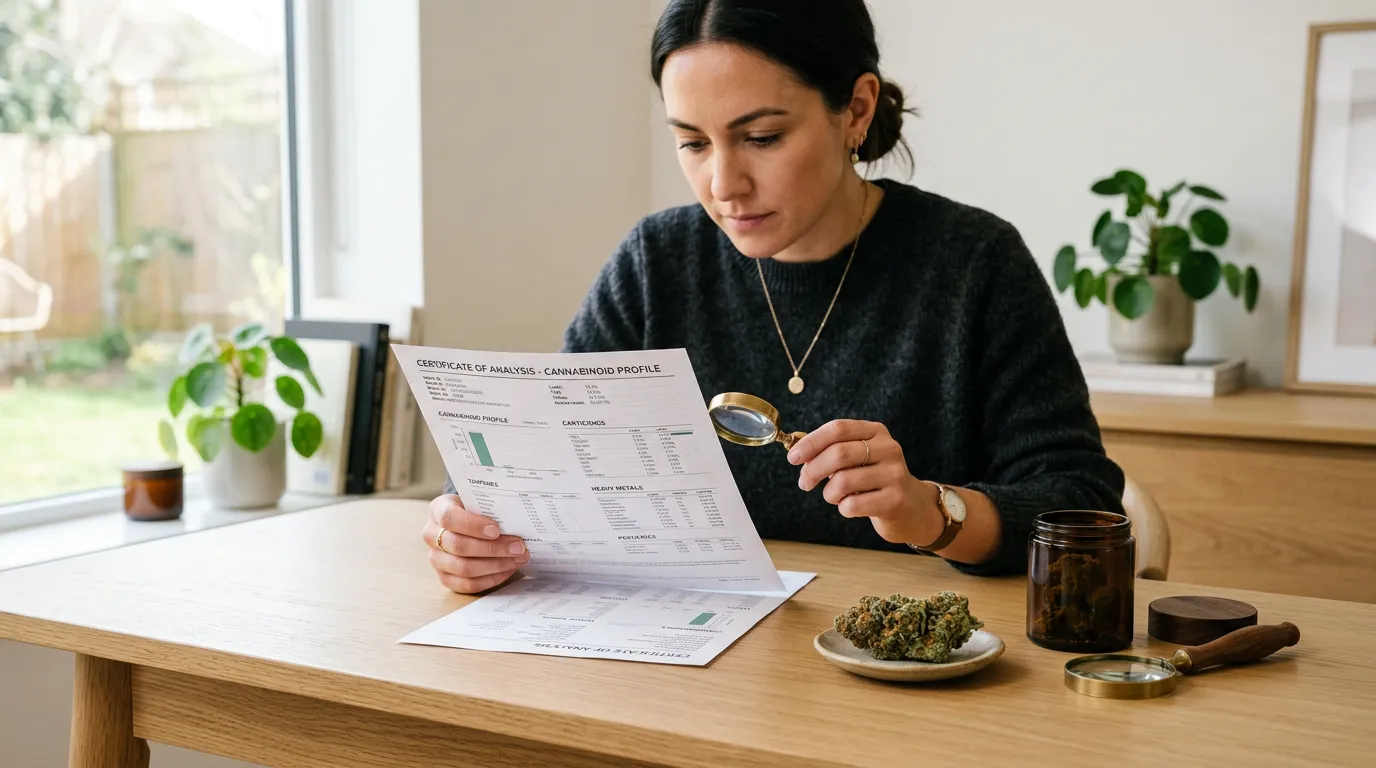
The CBD flower market in the United States has matured considerably since hemp was federally legalized under the 2018 Farm Bill, but the quality of products available varies enormously, and the gap between what a label claims and what a product actually contains remains a real problem. The only document that allows a buyer to verify the actual composition of a CBD flower independently of the retailer’s marketing claims is the certificate of analysis, commonly abbreviated as CoA, issued by an accredited third-party laboratory. Knowing how to read this document is one of the most practical skills any CBD flower buyer can develop, and it applies whether you are evaluating a generic hemp product or a premium California genetics variety like the OG Kush CBD whose terpene profile and genetic authenticity can be verified directly from the laboratory data.
What a certificate of analysis is and who should issue it
A certificate of analysis is a document issued by a laboratory that has tested a sample of the product and reports the results of that testing. The critical qualifier is third-party: the laboratory must be independent of the producer or retailer whose product is being tested. A certificate issued by a laboratory with a commercial relationship to the brand whose product it is certifying does not provide the independent verification that makes the document meaningful.
Accredited laboratories in the United States are typically accredited by the International Organization for Standardization under ISO/IEC 17025, which establishes the technical competence and management requirements for testing and calibration laboratories. Some states have established their own cannabis and hemp laboratory accreditation programs that incorporate ISO 17025 requirements alongside state-specific testing standards. A certificate that does not identify the issuing laboratory clearly, or whose laboratory does not have verifiable accreditation, does not offer the minimum guarantees required for informed purchasing.
The certificate must be lot-specific, meaning it must relate to the specific batch of product you are purchasing. A generic certificate that tests a strain without reference to a specific production lot, or a certificate dated many months before your purchase, does not tell you anything reliable about the product currently in your hand. Reputable retailers provide lot-specific certificates accessible directly from each product listing, often via a QR code that links to the original document on the laboratory’s server.
The cannabinoid panel : the numbers that matter most
The cannabinoid panel is the most important section of any CBD flower certificate of analysis. It lists the cannabinoids detected in the sample and their respective concentrations, typically expressed as a percentage of dry weight.
Total CBD is the figure that most buyers focus on, and it should match what the retailer advertises for the product. A meaningful discrepancy between the stated and measured CBD content is a significant red flag. Research from the Centre for Medicinal Cannabis in the UK documented substantial discrepancies between stated and measured cannabinoid content in samples from the European CBD market, and similar issues have been documented in the American hemp market. Independent verification through the certificate is the only way to confirm that the advertised CBD percentage corresponds to what you are actually purchasing.
Total THC is the figure that determines the legal status of the product. Under federal law in the United States, hemp and hemp-derived products must contain no more than 0.3% total THC. Some certificates report Delta-9 THC and THCA separately: THCA is the acid precursor of THC that converts to THC when exposed to heat, a process called decarboxylation. For a complete evaluation of THC content, the relevant figure is total THC calculated as Delta-9 THC plus 87.7% of THCA, which represents the conversion factor for THCA to THC. This calculated total THC figure is what determines whether a product is compliant with the federal 0.3% limit.
Minor cannabinoids including CBG, CBN, CBC and CBDV may also appear in the panel. The presence of these compounds in detectable concentrations indicates a full or broad spectrum product rather than a CBD isolate, with potential for greater entourage effect through the synergistic interaction of multiple cannabinoids.
The contaminant panels : what you are not supposed to see
A complete certificate of analysis for CBD flower includes several contaminant panels that verify the absence of substances that should not be present in a consumer product. These panels are often overlooked by buyers focused on the cannabinoid numbers, but they are equally important for product safety.
Pesticide testing should cover a comprehensive panel of agricultural chemicals that may have been used during cultivation. Hemp is a bioaccumulator that can concentrate pesticide residues from soil and spray applications, and these residues can reach significant concentrations in extracted products. The certificate should confirm that all tested pesticides are below action levels established by the relevant regulatory authority. A certificate that tests only a small number of pesticides rather than a comprehensive panel provides incomplete assurance.
Heavy metals testing typically covers lead, arsenic, cadmium and mercury, which can accumulate in hemp plants from contaminated growing soil. Hemp’s known phytoremediation capacity, its ability to extract contaminants from soil, makes heavy metal testing particularly important for products whose cultivation soil history is unknown. Results should confirm that all tested metals are below the action limits established by the FDA or the relevant state authority.
Microbial testing covers bacteria, mold and yeast contamination, and is particularly important for flower products intended for inhalation. The limits for microbial contamination in products intended for smoking or vaporization are stricter than for edible products, and results should be compared against the appropriate limits for the intended use.
Residual solvent testing is relevant primarily for extracts and concentrates rather than raw flower, but is included in the certificates of some products. For flower that has not been processed with solvents, this panel is less critical but its presence in a comprehensive certificate reflects positively on the thoroughness of the testing program.
The terpene panel : the data behind the aroma
The terpene panel is the most informative section of a CBD flower certificate for buyers who care about the aromatic character and specific variety of what they are purchasing. Not all certificates include terpene testing, and retailers who publish this information are providing a level of transparency that goes significantly beyond the regulatory minimum.
A terpene panel identifies and quantifies the major aromatic compounds present in the sample, typically expressed as a percentage of the total flower weight or in milligrams per gram. The dominant terpenes determine the aromatic character: myrcene produces earthy and fruity notes, limonene produces citrus notes, linalool produces floral and calming notes similar to lavender, and beta-caryophyllene produces spiced and woody notes.
For consumers who are purchasing a named strain like OG Kush, Gelato or Runtz, the terpene panel is the most direct way to verify that the product’s aromatic profile corresponds to the genetic heritage implied by the strain name. An authentic OG Kush CBD should show limonene as a dominant terpene with beta-caryophyllene and myrcene present in meaningful concentrations. A product labeled OG Kush that shows only myrcene dominance without significant limonene or caryophyllene is not expressing the terpene profile that defines the authentic strain, regardless of what the label says.
How to verify that a certificate is genuine
Verifying the authenticity of a certificate of analysis is a final step that most buyers skip but that is worth understanding, particularly when purchasing from unfamiliar retailers.
The laboratory name, address and accreditation number should be clearly stated on the certificate and verifiable through the accrediting body’s public registry. In the United States, laboratories accredited under ISO 17025 are listed in the ILAC MRA partner databases, and several state cannabis programs maintain their own public lists of accredited laboratories.
The certificate should include the analysis date, the lot or batch number of the tested sample, and the methodology used for each analysis. For cannabinoid testing, high-performance liquid chromatography is the accepted standard method. For terpene testing, gas chromatography is the standard. The presence of these methodological details in a certificate indicates laboratory rigor that is absent from documents that report only results without methodology.
Some retailers provide certificates with a QR code that links directly to the original document on the laboratory’s server, which eliminates the possibility of document manipulation by the retailer. This practice, adopted by the most transparent operators in the market, should be treated as a positive indicator of reliability when comparing potential suppliers.

